Always Watching: How Enestock's Docking Ecosystem Is Redefining Autonomous Surveillance
Enestock Insights · Intelligent Drone Docking Technology
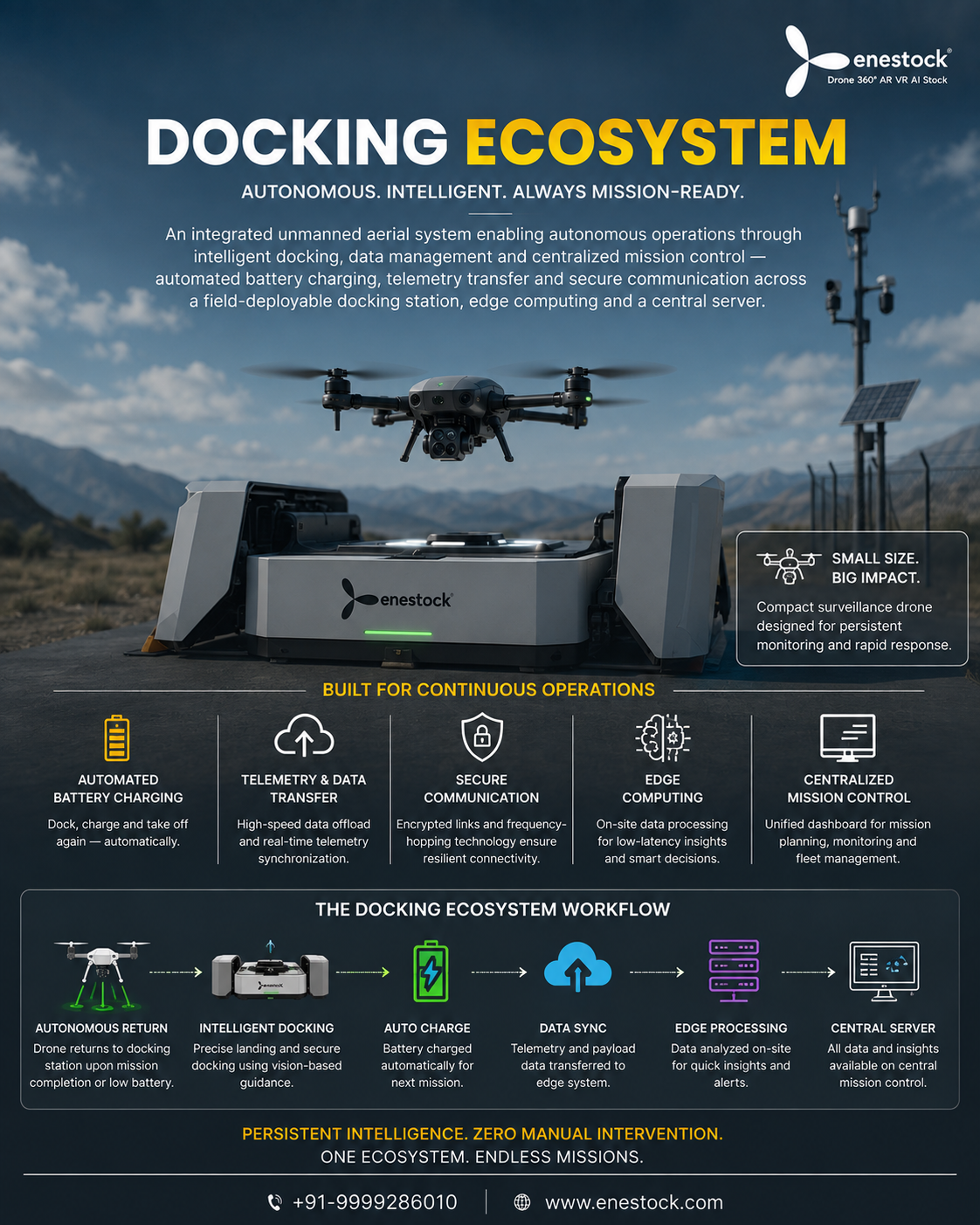
From Drone Operations to Autonomous Intelligence
Modern surveillance increasingly demands more than simply putting a drone in the sky. Remote sites, industrial facilities, infrastructure corridors, and large perimeters require continuous monitoring with minimal human intervention.
This is where Enestock's Docking Ecosystem comes into play — an integrated unmanned aerial system designed around a compact surveillance drone, an intelligent field-deployable docking station, edge computing, and centralized mission control.
Instead of treating the drone as an isolated aircraft, the ecosystem connects the entire operational cycle — deployment, flight, return, charging, data transfer, processing, and mission management — into one coordinated system.
The Intelligence Behind the Dock
What makes an autonomous drone ecosystem different from a conventional drone operation? The answer lies in what happens after the drone takes off.
Enestock's system is designed to automate the critical processes that normally require continuous operator involvement.
Automated Battery Charging
When the surveillance mission is completed or the drone requires recharging, it can return to its designated docking station. The docking system provides automated charging, preparing the aircraft for its next mission without requiring manual battery replacement or physical handling after every flight.
Intelligent Docking
Returning to a docking station requires precision. An intelligent docking mechanism is designed to help guide the drone safely back to its designated position, enabling repeatable autonomous operations from a fixed field location.
Telemetry & Data Transfer
Every flight generates valuable information. The ecosystem enables telemetry and mission data to be transferred through the docking infrastructure, reducing the need for operators to physically retrieve the aircraft or manually collect information after each mission.
Edge Computing
Not every piece of information needs to travel back to a distant server before it becomes useful. With edge computing capabilities, selected data can be processed closer to where it is generated, helping transform raw aerial information into faster operational insights.
Centralized Mission Control
At the heart of the ecosystem is centralized mission management. Operators can oversee missions, monitor drone status, review incoming information, and coordinate operations through a unified control environment. The result is a connected system rather than a standalone drone.
Built for Persistent Surveillance
The compact surveillance drone is designed to operate as part of the larger ecosystem, supporting recurring aerial monitoring across a defined area.
Infrastructure Monitoring
Large industrial sites and critical infrastructure can require regular visual inspection. An autonomous docking system can support scheduled aerial missions, allowing operators to collect recurring visual information without manually preparing and launching the drone for every flight.
Perimeter Surveillance
Large properties and restricted areas can be difficult to monitor continuously using conventional methods. A strategically positioned docking station can serve as an autonomous launch and recovery point, allowing the surveillance drone to conduct repeat missions across designated areas.
Remote Site Monitoring
Remote locations often present logistical challenges for conventional drone operations. By combining a field-deployable docking station with autonomous flight capabilities, the system is designed to reduce the need for constant on-site drone handling.
Industrial & Environmental Observation
From industrial facilities to remote landscapes, recurring aerial observation can help teams understand changes over time. Automated missions can create a consistent stream of aerial data that can subsequently be analyzed through edge and centralized computing systems.
One Ecosystem. Continuous Operations.
The real advantage of the Docking Ecosystem is the complete operational cycle:
- Deploy — The drone launches from its docking station for a scheduled or assigned mission.
- Monitor — The compact UAV collects aerial imagery, telemetry, and other mission data.
- Return — After completing its mission, the drone autonomously returns to its designated docking point.
- Recharge — The docking station automatically restores the drone's available flight capacity.
- Transfer — Collected mission information and telemetry are transferred through the connected infrastructure.
- Process — Edge computing can process relevant information locally for faster insights.
- Control — Processed information is made available through centralized mission control for monitoring and decision-making.
And then the cycle begins again.
From Autonomous Flight to Autonomous Infrastructure
The future of drone technology isn't simply about making drones smarter.
It is about creating complete ecosystems where drones, docking stations, computing systems, communication networks, and human operators work together seamlessly.
Enestock's Docking Ecosystem takes this approach by connecting the aircraft with the infrastructure surrounding it — turning a small surveillance drone into part of a persistent, connected aerial monitoring system.
Whether deployed at an industrial facility, remote site, infrastructure corridor, or surveillance perimeter, the objective remains the same:
Less manual intervention. More continuous intelligence.
The Future Is Always On
As autonomous systems become increasingly integrated into everyday operations, drone deployments are moving from occasional flights toward continuous, data-driven monitoring.
Enestock's Docking Ecosystem is designed for this transition — combining intelligent docking, automated charging, secure communication, telemetry transfer, edge computing, and centralized mission control into a unified platform.
The drone doesn't simply fly.
It returns. It recharges. It transfers data. It learns from every mission. And it goes again.
One ecosystem. Continuous surveillance. Autonomous intelligence.