Vertical Freedom, Fixed-Wing Endurance: How Fixed-Wing VTOL UAVs Are Transforming Aerial Operations
Enestock Insights · Fixed-Wing VTOL Technology
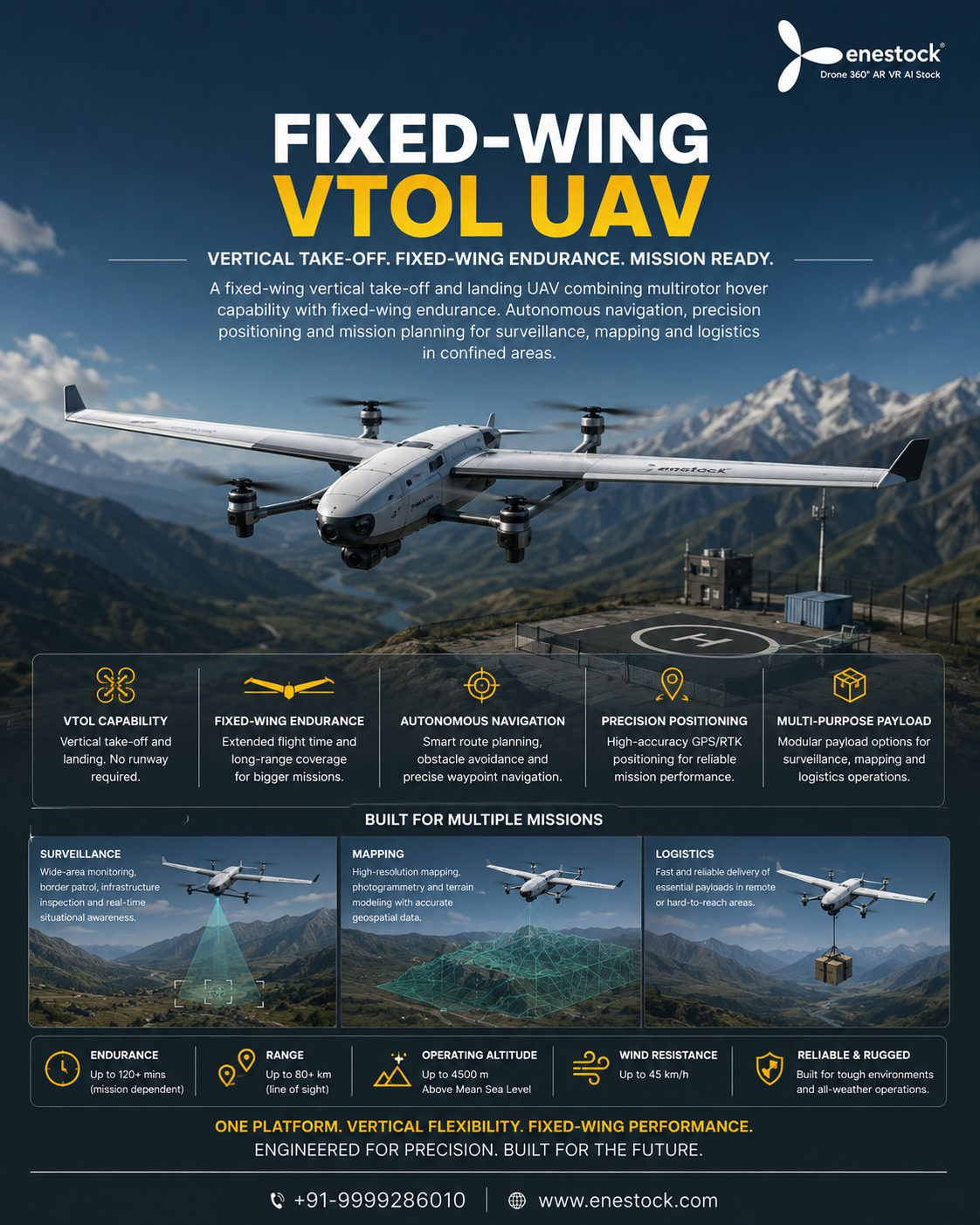
The Best of Both Worlds
Traditional multirotor drones offer excellent maneuverability and the ability to take off and land vertically. Fixed-wing aircraft, on the other hand, are better suited for covering larger areas and conducting longer-duration missions.
But what if one aircraft could combine both?
The Fixed-Wing VTOL UAV brings together the vertical mobility of a multirotor with the endurance and flight efficiency of a fixed-wing aircraft.
Designed for operations where conventional runways are unavailable or impractical, the platform can take off vertically from confined locations, transition into efficient forward flight, and return to a precise landing point when the mission is complete.
The result is a versatile aerial platform designed for surveillance, mapping, surveying, and logistics operations across challenging environments.
Designed for Maximum Operational Flexibility
What makes a Fixed-Wing VTOL UAV different from a conventional drone? Its ability to change the way it flies according to the mission.
The platform combines several core technologies:
VTOL Capability
Vertical take-off and landing eliminates the need for a conventional runway. This allows the UAV to operate from confined areas, remote sites, rooftops, temporary field locations, and other environments where traditional fixed-wing aircraft cannot easily operate.
Fixed-Wing Endurance
Once airborne, the aircraft transitions into fixed-wing flight. Its aerodynamic design allows it to travel efficiently across larger areas, making it suitable for missions requiring extended aerial coverage rather than short-duration hovering.
Autonomous Navigation
Advanced navigation systems allow the UAV to follow predefined routes, manage waypoints, and execute planned missions with reduced dependence on continuous manual piloting. This enables repeatable and consistent aerial operations across large or difficult-to-access areas.
Precision Positioning
High-accuracy positioning technology supports reliable navigation, mapping, and mission execution. Precise location data can help ensure that the UAV follows planned flight paths while also improving the accuracy of aerial mapping and surveying outputs.
Mission Planning
Before take-off, operators can define the mission area, flight path, waypoints, and other operational parameters. The UAV then combines these instructions with its onboard navigation systems to execute the planned mission efficiently.
Built for Multiple Missions
The strength of a Fixed-Wing VTOL UAV lies in its ability to support different types of aerial operations from the same platform.
Wide-Area Surveillance
Monitoring large areas can be challenging when relying solely on ground-based teams or short-endurance multirotor drones. The Fixed-Wing VTOL platform can cover larger areas while maintaining the flexibility to operate from confined locations. It can support applications such as infrastructure monitoring, perimeter observation, environmental surveillance, and situational awareness.
Mapping & Surveying
Accurate aerial data is becoming increasingly important across construction, infrastructure development, land management, and surveying. The UAV can follow planned flight paths over defined areas while collecting consistent aerial imagery for mapping and photogrammetry applications. Its autonomous navigation and precision positioning capabilities help create reliable geospatial datasets for analysis and planning.
Infrastructure Inspection
Large infrastructure projects often extend across difficult terrain and wide geographical areas. A VTOL UAV can be deployed from a suitable nearby location and efficiently cover the required inspection area without the need for a runway. This makes the platform useful for monitoring roads, pipelines, power infrastructure, construction sites, and other large assets.
Logistics & Remote Delivery
Remote locations can present significant challenges for conventional transportation. A Fixed-Wing VTOL platform can combine vertical take-off capability with efficient forward flight, making it suitable for selected lightweight logistics applications where direct access by conventional vehicles may be difficult.
From Confined Spaces to Wide-Area Operations
The biggest advantage of the platform is its operational flexibility.
A conventional fixed-wing UAV may require a runway or launch mechanism. A conventional multirotor may be easy to deploy but typically sacrifices endurance when covering large areas.
The Fixed-Wing VTOL approach bridges this gap.
Vertical take-off. Efficient forward flight. Autonomous navigation. Precision positioning. Vertical landing.
This combination enables aerial missions to begin and end in locations that would otherwise be difficult for fixed-wing aircraft to access.
One Platform. Multiple Possibilities.
The Fixed-Wing VTOL UAV is designed around adaptability.
Its architecture can support different mission configurations depending on operational requirements, including aerial imaging, mapping sensors, surveillance equipment, and logistics payloads.
This modular approach allows organizations to use the same basic aircraft platform across multiple applications rather than deploying completely different systems for every mission.
Whether the objective is surveying a remote landscape, monitoring infrastructure, mapping a construction site, or delivering lightweight supplies, the platform is built around one fundamental principle:
Maximum aerial capability with minimum deployment limitations.
The Future of Efficient Autonomous Flight
As industries increasingly depend on accurate aerial data and autonomous operations, the demand for UAVs that can operate farther, smarter, and from more challenging locations will continue to grow.
The Enestock Fixed-Wing VTOL UAV combines the vertical accessibility of multirotors with the efficient flight characteristics of fixed-wing aircraft, creating a flexible platform for the next generation of aerial missions.
From confined launch sites to wide-area flight paths, it brings together autonomous navigation, precision positioning, mission planning, and multi-purpose payload capability in a single system.
The future of aerial operations isn't about choosing between a multirotor and a fixed-wing aircraft.
It's about having both capabilities in one platform.
Vertical flexibility. Fixed-wing endurance. Autonomous performance.