Built to Lift: How 50 kg Heavy-Lift Drones Are Transforming Aerial Logistics
Enestock Insights · Heavy-Lift Drone Technology
When the Mission Requires More Than a Camera
Drones have traditionally been associated with lightweight cameras, sensors, and small payloads. But as unmanned aviation continues to mature, a new category is emerging — UAVs designed not simply to observe from the sky, but to carry meaningful loads to places that are difficult to reach by conventional means.
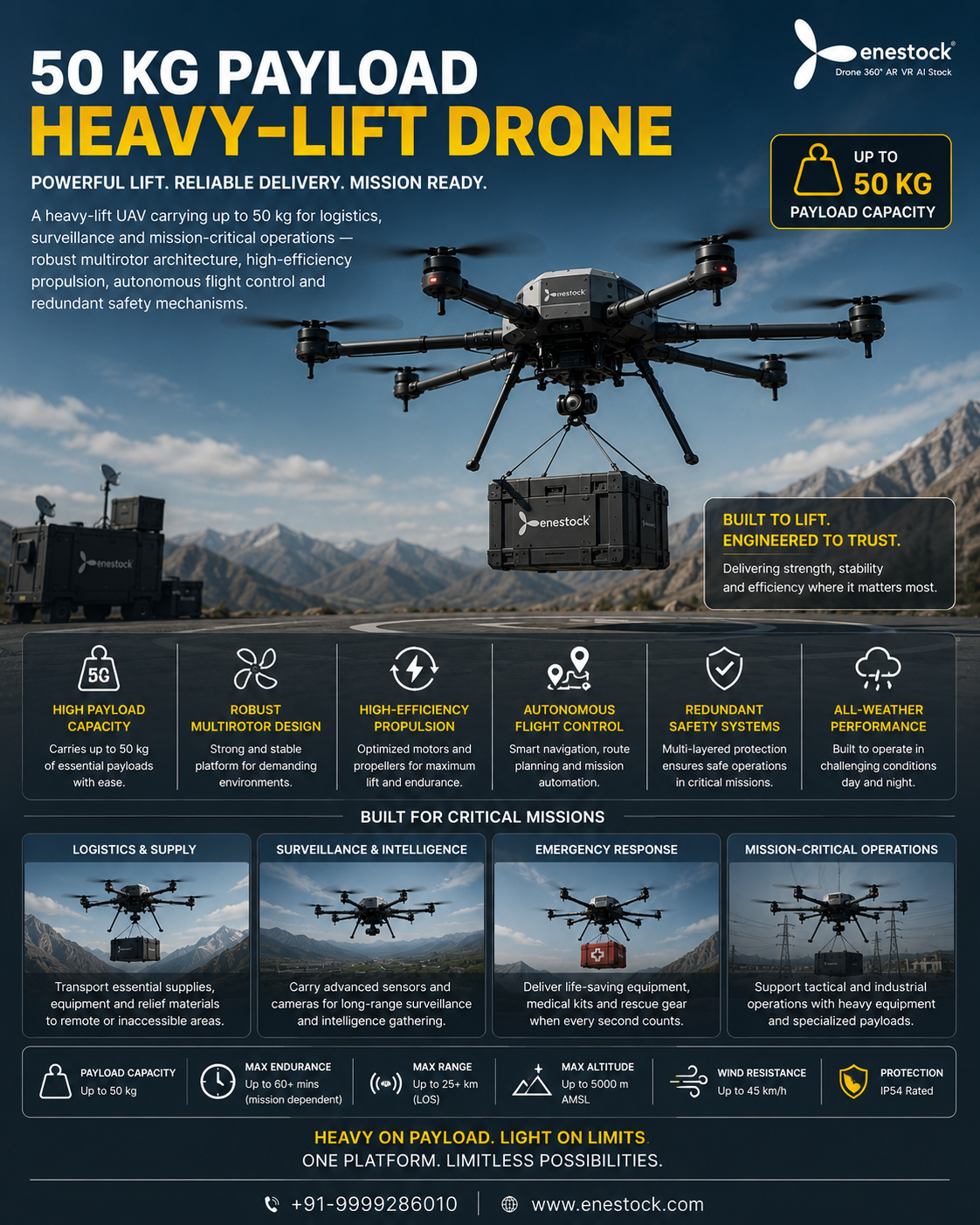
The Enestock 50 kg Payload Heavy-Lift Drone is designed for exactly this purpose.
Built around a robust multirotor architecture, the platform can carry payloads of up to 50 kg, opening new possibilities for logistics, surveillance, emergency response, and other mission-critical operations.
Its combination of high-efficiency propulsion, autonomous flight control, and redundant safety mechanisms creates a platform designed around one fundamental objective:
Lift more. Operate reliably. Reach farther.
Engineered for Heavy Payloads
Carrying a significantly larger payload requires more than simply adding larger motors.
The entire aircraft must be engineered around stability, propulsion efficiency, flight control, and safety.
The Enestock Heavy-Lift UAV brings these elements together through a purpose-built architecture.
High Payload Capacity
With a payload capacity of up to 50 kg, the platform can transport equipment, supplies, sensors, and other mission-specific loads that would be impractical for conventional smaller drones. This transforms the UAV from a surveillance platform into a potential aerial logistics system.
Robust Multirotor Architecture
A heavy payload requires a stable and controlled aircraft. The multirotor configuration provides the ability to hover, maneuver precisely, and operate from confined locations while carrying substantial loads.
High-Efficiency Propulsion
Heavy-lift operations place significant demands on the propulsion system. High-efficiency motors and propulsion components are designed to generate the required lift while maintaining operational efficiency across demanding missions.
Autonomous Flight Control
Carrying a heavy payload makes precise flight management particularly important. Autonomous flight-control systems can assist with navigation, route planning, flight stability, and mission execution, reducing the workload on operators.
Redundant Safety Mechanisms
Mission-critical aerial operations require multiple layers of protection. Redundant systems can help maintain operational resilience by providing additional safeguards across critical aircraft functions.
More Than Transportation
The ability to carry up to 50 kg creates opportunities across multiple industries and operational environments.
Logistics & Supply Delivery
Moving supplies into remote or difficult-to-access areas can be expensive, time-consuming, and sometimes dangerous. A heavy-lift UAV can provide an alternative aerial delivery method for transporting essential equipment, supplies, and materials where conventional ground transportation faces limitations. This can be particularly valuable in mountainous, isolated, or infrastructure-constrained regions.
Emergency Response
During emergencies, access to affected locations may be restricted by damaged roads, difficult terrain, or other obstacles. A heavy-lift drone can support response teams by transporting selected emergency supplies, rescue equipment, medical kits, and other essential payloads directly to designated areas. The ability to operate vertically also allows deployment without requiring a conventional runway.
Surveillance & Sensor Deployment
The aircraft's payload capacity isn't limited to physical cargo. The platform can also support heavier or more capable surveillance equipment, sensors, cameras, and specialized mission payloads. This allows operators to configure the aircraft according to the requirements of a particular operation.
Industrial Operations
Industrial environments often involve moving equipment and materials across large facilities or difficult terrain. Heavy-lift UAVs can potentially support selected material-transfer operations, reducing the need for ground vehicles in situations where aerial delivery offers an operational advantage.
Designed for Mission-Critical Operations
Heavy-lift UAVs operate in a different category from conventional consumer drones.
When the aircraft is carrying a substantial payload, reliability becomes just as important as lifting capability.
The Enestock platform is therefore designed around multiple elements working together:
Payload → Propulsion → Flight Control → Navigation → Safety
Each component contributes to the overall mission.
A capable propulsion system provides lift. Autonomous flight control manages the aircraft. Navigation systems guide the mission. Redundant safety mechanisms add resilience. And the payload architecture allows the aircraft to be configured for the task at hand.
The result is a complete heavy-lift aerial platform rather than simply a larger drone.
Vertical Capability, Heavy-Lift Performance
One of the major advantages of a multirotor heavy-lift platform is its ability to operate vertically.
There is no requirement for a traditional runway.
The UAV can take off from a suitable confined location, reach the required operating altitude, transport its payload, and return vertically to its designated landing area.
This makes the concept particularly relevant for environments where accessibility is the challenge.
Remote construction sites, mountainous regions, industrial facilities, emergency zones, and isolated locations can all present situations where conventional transport becomes difficult.
One Platform. Multiple Payloads.
The aircraft is designed around a modular approach to mission configuration.
Instead of developing a completely different aircraft for every application, the same heavy-lift platform can be adapted around different payload requirements.
Possible configurations can include:
- Logistics and supply containers
- Surveillance and imaging equipment
- Specialized sensors
- Emergency-response equipment
- Industrial tools and equipment
- Mission-specific payload systems
This flexibility allows the UAV to evolve with the mission rather than limiting it to a single operational role.
The Future of Aerial Logistics
The future of drones isn't only about collecting information from above.
It is also about moving things through the air.
As autonomous flight technology, propulsion systems, and flight-control capabilities continue to develop, heavy-lift UAVs can become increasingly relevant to logistics, emergency response, industrial operations, and remote-area support.
The Enestock 50 kg Payload Heavy-Lift Drone represents this shift — combining substantial payload capacity, robust multirotor architecture, efficient propulsion, autonomous flight control, and redundant safety mechanisms into a single platform.
From delivering essential supplies to carrying sophisticated equipment, the goal is straightforward:
Make heavy loads easier to move.
Heavy on payload. Strong on capability. Built for the missions that matter.