Built to Take the Impact: How Indoor Drones Are Changing Reconnaissance in Confined Spaces
Enestock Insights · Impact-Resistant Indoor Drone Technology
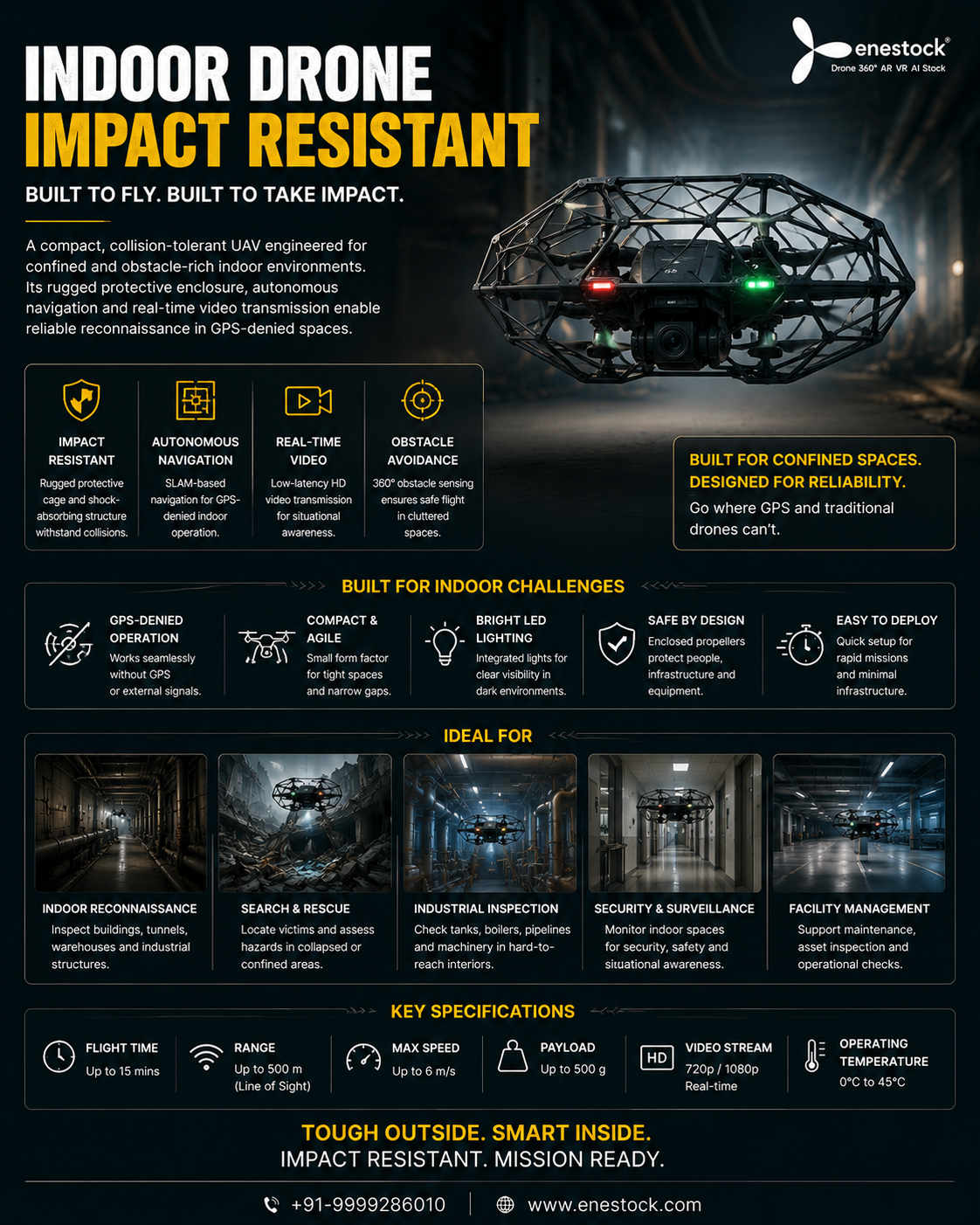
Where Conventional Drones Struggle, Rugged UAVs Step In
Most drones are designed with open skies in mind.
But some of the most challenging environments for aerial operations are not thousands of metres above the ground. They are inside buildings, tunnels, warehouses, industrial facilities, damaged structures, and other confined spaces where obstacles are everywhere and GPS signals may be unavailable.
This is where the Enestock Indoor Impact-Resistant Drone is designed to operate.
Compact, rugged, and built for collision-tolerant flight, the platform combines a protective enclosure with autonomous navigation and real-time video transmission.
The objective is simple:
Go where conventional drones can't.
Built for the Indoor Environment
Flying indoors creates a completely different set of challenges.
Walls, ceilings, pipes, cables, machinery, narrow corridors, and limited visibility can make conventional drone operation difficult. Without reliable GPS, even basic navigation becomes more complicated.
The Enestock Indoor Drone is designed around these challenges.
Impact-Resistant Protection
The drone features a rugged protective enclosure designed to absorb contact and help protect the aircraft during collisions. Instead of treating every impact as a mission-ending event, the protected architecture is designed to make operation more practical in environments where contact with surrounding structures may occur.
Autonomous Navigation
Indoor environments often lack reliable GPS signals. The platform uses autonomous navigation technologies to help understand its surroundings, estimate its position, and move through confined spaces without relying solely on satellite navigation.
Obstacle Avoidance
Indoor environments can change quickly. Real-time obstacle sensing helps the UAV identify objects around its flight path and adjust its movement accordingly, supporting safer navigation through cluttered spaces.
Real-Time Video
Aerial reconnaissance is only useful when operators can see what the drone sees. Real-time video transmission allows teams to receive an aerial view of the environment while the UAV is operating, providing valuable situational awareness without requiring personnel to physically enter the area first.
Designed for GPS-Denied Environments
One of the biggest challenges of indoor flight is the absence of conventional satellite positioning.
Outside, GPS can help a drone determine where it is.
Inside a building, tunnel, basement, or industrial structure, that signal may be weak or unavailable.
The Indoor Drone is therefore designed around navigation methods suited to GPS-denied environments, allowing autonomous operation based on its understanding of the surrounding environment.
This capability makes it particularly relevant for locations where conventional outdoor UAV navigation systems are not enough.
Built for Challenging Missions
The combination of compact design, impact resistance, autonomous navigation, and live video opens up several practical applications.
Indoor Reconnaissance
Before personnel enter an unfamiliar or potentially hazardous structure, a drone can provide an aerial perspective of the environment. It can support reconnaissance inside buildings, warehouses, tunnels, industrial structures, and other confined areas.
Search & Rescue
Collapsed structures and damaged buildings can contain unstable debris and inaccessible spaces. A compact impact-resistant UAV can help search teams inspect difficult areas and gather visual information before responders move deeper into the environment.
Industrial Inspection
Industrial facilities often contain tanks, machinery, pipes, confined passages, and other difficult-to-access areas. An indoor UAV can provide visual inspection capabilities while reducing the need for personnel to physically access every location.
Security & Surveillance
Large indoor facilities can be difficult to monitor manually. An autonomous indoor drone can provide aerial observation across selected areas, supporting security teams with an additional source of situational awareness.
Facility Management
Warehouses, commercial buildings, and industrial facilities require regular inspection and maintenance. A compact UAV can assist with visual checks of hard-to-reach areas, helping teams identify conditions that may require further attention.
Small Size. Big Advantage.
In indoor environments, being large is often a disadvantage.
A compact aircraft can move through spaces that would be inaccessible to larger UAVs.
Narrow corridors, doorways, industrial interiors, and cluttered environments require a different approach to aerial design.
The Indoor Drone is therefore built around compact maneuverability and protective architecture, allowing it to operate closer to obstacles while maintaining a practical aerial perspective.
A Safer Way to See What's Ahead
One of the most valuable applications of indoor drones is their ability to provide information before people enter a potentially difficult environment.
Instead of immediately sending personnel into an unfamiliar structure, teams can first deploy the UAV to assess conditions remotely.
The drone can provide:
- Aerial visibility.
- Real-time video.
- Environmental awareness.
- Obstacle information.
- Remote reconnaissance.
This can help teams make more informed decisions before committing personnel and equipment to the area.
From Reconnaissance to Real-Time Intelligence
The role of an indoor drone is not simply to fly through a building.
It is to turn difficult-to-access environments into visible, actionable information.
By combining autonomous navigation, obstacle avoidance, impact-resistant protection, and real-time video transmission, the Enestock Indoor Drone creates a platform designed specifically for environments where conventional aerial systems face limitations.
Whether navigating a warehouse, inspecting an industrial interior, exploring a tunnel, or assisting responders inside a damaged structure, the system is built around one principle:
Information first. People safer. Missions smarter.
The Future of Indoor Autonomous Flight
As drones become increasingly autonomous, their applications are moving beyond open outdoor environments.
The next generation of UAVs will need to operate in places where GPS is unavailable, obstacles are unavoidable, and physical contact may be part of the mission.
The Enestock Indoor Impact-Resistant Drone addresses these requirements through a combination of rugged protection, autonomous navigation, obstacle avoidance, compact maneuverability, and real-time video transmission.
It is not designed to compete with conventional outdoor drones.
It is designed for the places where conventional drones struggle.
Tough outside. Smart inside.
Built to enter. Designed to endure. Engineered to see.