Three Controllers, One Mission: How Redundant Flight Control Is Making UAVs More Reliable
Enestock Insights · Failsafe Flight Control Technology
When Flight Reliability Matters
For many drone applications, a flight-control failure can mean more than a cancelled mission. It can result in the loss of valuable equipment, interruption of critical operations, or an inability to safely complete the mission.
As UAVs become increasingly autonomous and are deployed in more demanding environments, flight-control reliability has become a fundamental part of aircraft design.
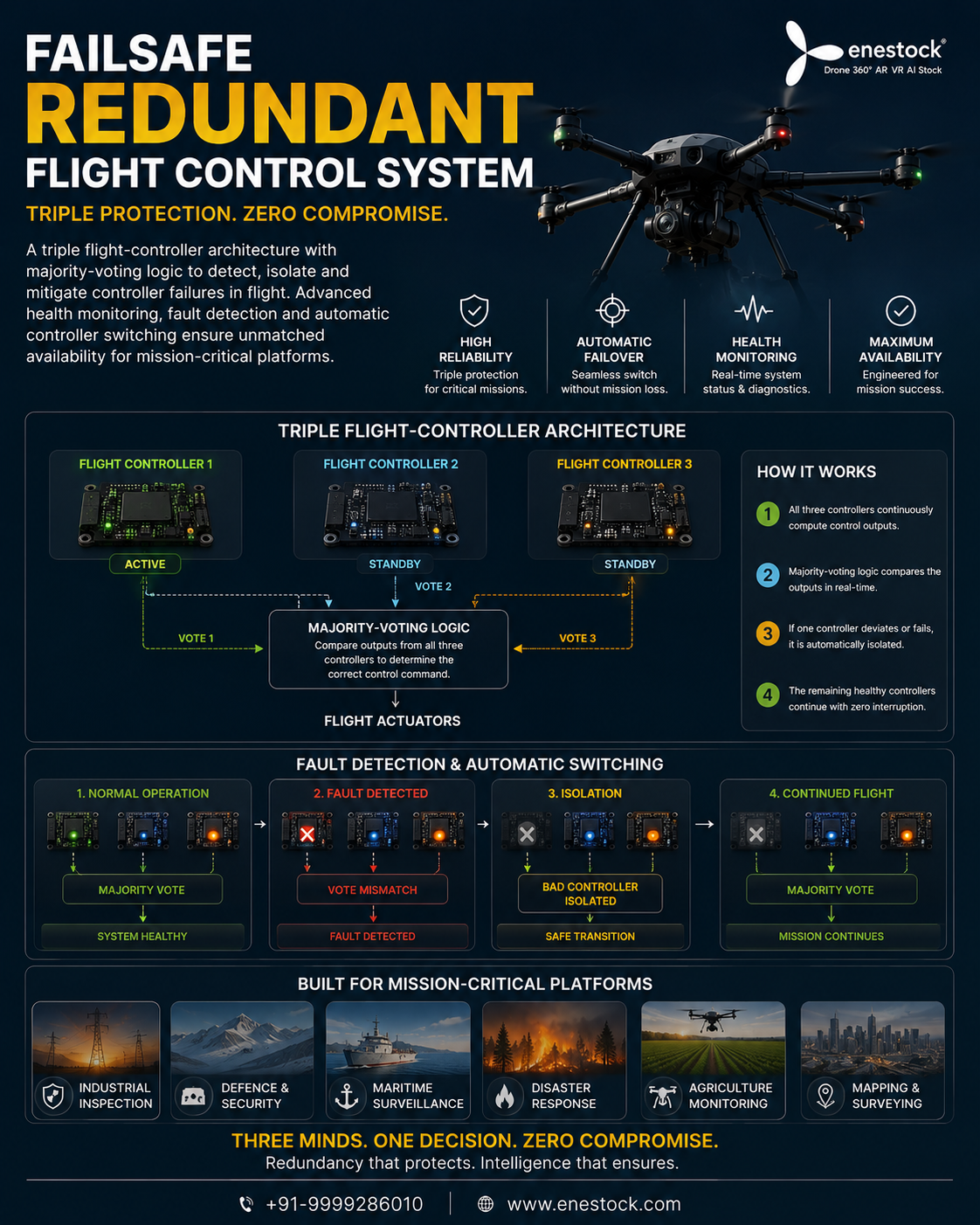
Enestock's Failsafe Redundant Flight Control System addresses this challenge through a triple flight-controller architecture.
Instead of relying on a single controller to make every flight decision, the system uses three independent flight-control units working together with majority-voting logic.
The objective is straightforward:
Detect the problem. Isolate the failure. Keep the mission moving.
Three Controllers. One Trusted Decision.
Traditional UAV architectures can depend heavily on a single primary flight controller.
A redundant architecture introduces additional control units that continuously evaluate the aircraft's flight state and generate control information.
The three controllers work together to create a more resilient control architecture.
Triple Flight-Controller Architecture
Three independent controllers provide multiple sources of flight-control information. This creates redundancy within one of the most important systems on the aircraft. If one controller produces an unexpected result or experiences a fault, the remaining controllers can provide additional information for determining the appropriate control response.
Majority-Voting Logic
The system uses majority voting to compare the outputs of the three controllers. Rather than automatically trusting a single controller, the architecture looks for agreement between the available control outputs. This allows the system to identify inconsistencies and determine the control decision supported by the majority.
Continuous Health Monitoring
Redundancy becomes significantly more useful when the system can recognize when something is going wrong. Health-monitoring functions continuously assess controller status and system behavior, helping identify abnormal conditions before they become larger operational problems.
Fault Detection & Isolation
When a controller deviates from expected behavior, the system can detect the inconsistency and isolate the affected controller from the active decision-making process. This prevents a detected controller fault from unnecessarily compromising the entire flight-control architecture.
Automatic Switching
Once a fault is identified, the system can automatically transition control responsibility to the healthy controller combination. The goal is to reduce the need for immediate manual intervention and maintain stable aircraft operation.
How the Failsafe Architecture Works
The system can be understood through a simple four-stage process.
- Normal Operation — All three flight controllers continuously generate and evaluate flight-control information.
- Fault Detection — The system identifies an abnormal controller output or health condition.
- Fault Isolation — The affected controller is separated from the trusted control decision.
- Continued Operation — The remaining healthy controllers continue providing the control information required for flight.
This architecture is designed to ensure that a single controller failure does not automatically become a complete flight-control failure.
Built for Mission-Critical Platforms
Not every drone mission has the same reliability requirements.
For routine recreational flights, a controller failure may simply mean the end of a flight.
For mission-critical UAVs, however, reliability can be essential.
Industrial Inspection
UAVs operating around infrastructure such as power systems, industrial facilities, and large structures need dependable flight-control performance. Redundant control architecture can add an additional layer of resilience during inspection missions.
Defence & Security
Autonomous platforms operating in demanding environments require robust onboard systems. A redundant flight-control architecture can help maintain operational continuity when unexpected system conditions occur.
Maritime Surveillance
Operating over water can make recovery particularly challenging if an aircraft experiences a serious failure. Additional flight-control redundancy can provide greater resilience for long-duration maritime missions.
Disaster Response
Emergency environments can be unpredictable, making system availability particularly important. Redundant flight control can help support UAV operations where consistent aerial access is required for observation and response.
Mapping & Surveying
Large-area mapping missions can involve long flight paths and significant amounts of collected data. Maintaining reliable flight control throughout the mission helps protect both the aircraft and the quality of the resulting mission data.
Redundancy Is More Than Backup
A common misconception is that redundancy simply means having a spare component waiting to take over.
A sophisticated redundant flight-control system goes further.
The controllers continuously participate in the system's decision-making architecture. Their outputs can be compared against one another, allowing inconsistencies to be identified while the aircraft remains in operation.
This creates a layered approach to flight reliability:
Monitor → Compare → Detect → Isolate → Switch → Continue
The system is therefore designed not only to respond to failures, but to recognize and manage them as part of the flight-control process.
Designed for Autonomous Operations
As UAVs become more autonomous, onboard intelligence becomes increasingly important.
An aircraft operating with a high degree of autonomy cannot always depend on an operator to identify every abnormal condition and react immediately.
The flight-control system therefore needs to monitor itself.
Health monitoring, fault detection, majority voting, and automatic switching create a foundation for more resilient autonomous operations.
This becomes particularly important as UAVs move toward increasingly complex missions where availability and reliability are as important as navigation and payload performance.
Reliability Through Intelligent Architecture
The Enestock Failsafe Redundant Flight Control System is built around a simple engineering principle:
Don't rely on one decision when three can provide greater confidence.
By combining a triple-controller architecture with majority-voting logic, continuous health monitoring, fault detection, isolation, and automatic switching, the system is designed to improve the availability and resilience of mission-critical UAV platforms.
It isn't about expecting a failure.
It's about being prepared when one occurs.
The Future of Safer Autonomous Flight
As drones move beyond simple remote-controlled operations toward autonomous surveillance, mapping, logistics, and mission-critical applications, the importance of resilient onboard systems will only increase.
Flight-control redundancy provides one of the foundations for this transition.
Enestock's approach combines three flight controllers, intelligent voting logic, continuous system health monitoring, and automatic fault management into a unified safety architecture.
The result is a UAV control system designed to remain dependable even when individual components encounter unexpected conditions.
Three controllers. One trusted decision. One mission that keeps moving.
Redundancy that protects. Intelligence that responds. Reliability that matters.